My autism newsfeed was inundated with this story, “Dad Discovers He Has Autism after His Daughter is Diagnosed!”

Subtitle: Autism, a neurological difference or a snapshot of evolution in realtime?

I use the Google Alert feature to keep up with all of the stories on the internet about autism on a daily basis.

The other day my Google Alert email was inundated with a story about an Australian father who discovered he’s autistic after his daughter was diagnosed.

WTF? Why was this story picked up by multiple news outlets as something worth reporting?

I ask that question because there are thousands of stories just like this one every day.

I’m one of those stories [sort of]. I was 59 years old when I finally learned what the word “autistic” meant which I heard numerous times from the age 6 until I was a teenager. However, nobody, including my mother, ever explained to me what that was all about.

Autism is still a statistician’s dream puzzle to estimate. We keep hearing new updates on the ratio of autism to the general populace annually.

In less than two decades, the statistics have morphed from 1 in 2000 to 1 in 45. Those numbers primarily refer to males, and the ratio of male to female autistics has generally stayed the same, four boys to every girl.

There have been lots of suppositions about those decreasing ratios, and the main argument is that the diagnostic process has improved.

My personal theory is that autism is part of human evolution. If we remove the comorbid condition of Intellectual Disability, most autistics have an above average IQ along with a myriad of special gifts. Those gifts are not universal among all autistics, they are a spectrum just like the negative aspects of autism.

A good analogy is Star Trek and Mr. Spock. Mr. Spock looked similar to humans but he had an amazing ability to problem solve using his gift of incredible logic.

I think pretty logically too, and it is logical to me that autism is a snapshot of human evolution in realtime regardless of what causes it…

[To be continued…]

Story on Parenting.com website

OMG! My autism is missing?

Subtitle: well not really, it’s just taking a break…

I’ve been pretty sick for the past two months. First it was a nasty Sjogren’s Syndrome flare-up (Lupus Lite) then followed by a sinus infection which turned into bacterial pneumonia.

Yikes! 🙂

Consequently I’ve been cramming anti-inflammatory drugs down my throat to fight these little attackers.

In mid-January I started my ritual steroid protocol (Prednisone) to battle the flare-up, and when the sinus infection/pneumonia kicked in, my doctor put me on antibiotics along with mega doses of ibuprofen (NSAID). I’m still taking Prednisone, one of the first anti-inflammatory and immunosuppressant drugs invented.

All of the drugs above assist with immune dysregulation by quieting down one’s autoantibodies along with fighting the pneumonia bacteria.

Last night I was doing my favorite hobby, thinking, and it occurred to me that some of my autistic traits (OCD) have been dormant for the past few weeks and I wondered how that happened?

That triggered my internal computer processor (brain) to tap into my database (knowledge) looking for correlations based on past research.

The first data that popped up in my thought processes were the anecdotal reports by parents of severely autistic children being miraculously cured of their autism by ingesting antibiotics and other anti-inflammatory drugs. To be fair and accurate, those miraculous cures were only temporary during the course of taking those drugs.

However, if those stories are true then it could be inferred that inflammation is a culprit in the autism mystery.

What is inflammation?

Inflammation is the body’s way of fighting attack. Ideally, when a “foreign” substance, a toxin, bacteria, or a virus enters the body, a cascade of inflammatory chemicals and processes ramp up to fight off the invader. When the battle is over, an anti-inflammatory process begins and calms the body down again.

In some people, this process of ramping up and cooling down does not go smoothly. Those people can become stuck in a constant state of inflammation, a state of battle, in which the body produces chemicals such as cytokines. Over time, these inflammatory chemicals can damage the body.

Over the past decade, there have been numerous research studies substantiating a relation between mothers with autoimmune diseases having a much higher chance of having babies with some form of autism. Those autoimmune diseases can be diabetes associated with obesity, asthma, or more severe autoimmune diseases such as Lupus.

When I consider those studies, I think of my own case. My mother had severe asthma and a chronic skin condition that was probably cutaneous Lupus. In addition, she was 39 years old when I was born and other studies point to older mothers having a higher chance of giving birth to an autistic child. And to top it off, she was a daily smoker.

Assuming all of this scientific gibberish, facts, research, and hypotheses are correct, what is that going to tell us?

First we’re not going to eradicate autism nor are we going to stop making babies just because a mother has an autoimmune disease or is over 35 years old. That’s silly.

Second most autistics, myself included, do not want to change the way that we are. We’re comfortable being ourselves and we’re used to the way that our brains function and think.

However it is plausible that we can mitigate some of the autistic traits that most autistics complain about, i.e. our social ineptness and our inability to make friends and assimilate amongst non-autistics, especially if a biological process, inflammation, is playing a part by affecting our brains.

The infamous and vile concept of ABA tries to reprogram our behaviors via the old fashioned reward and punishment methods. Many parents of autistic children swear it works. I practiced this on myself as an adult and it does work. However, in the process I was stressed out so much that it caused immense anxiety.

As an alternative, if my theory might have some credibility, a simple daily cocktail of non-steroidal anti-inflammatory drugs might produce the same results, i.e. Ibuprofen (Advil).

As a scientist I like to run experiments. Therefore, I’m going to continue with this one because I need to in order to mitigate my other severe problem, an autoimmune disease called Sjogren’s Syndrome, and if it happens to tone down my OCD and ADHD propensities, then hallelujah! 🙂

I posed the question in a previous post, “Is autism an autoimmune disease?”

It just might be…

[To be continued…]

Link to Autism Research Institute: Immune Function & ASD

Link to YouTube Video Dr. Judy Van de Water, UC Davis MIND Institute, Biomarkers & ASD

Link to UC Davis MIND Presentation Handout:

PubMed research paper:

A Meta-Analysis of Maternal Smoking during Pregnancy and Autism Spectrum Disorder Risk in Offspring

Sometimes when the shoe fits, it’s quite painful…

Subtitle: Being autistic and getting old is the pits…

I ran across the attached article a few days ago and it resonated with me profoundly.

I’m old, in my third trimester of life at the age of 64, I suffer depression daily, and my physical health has diminished as well due to a comorbid autoimmune disease, Sjogren’s Syndrome.

It’s hard for me to pinpoint which is worse, the lack of realtime friends and family or the daily struggles dealing with a chronic disease.

It’s also hard for me to figure out whether or not the depression is caused by either of those ancillary aspects or whether or not the depression fuels the physical symptoms and the inability to socialize.

In the end it doesn’t matter. It is what it is and I have to deal with it.

I used to relish spending a few hours every night connecting with others on the various Facebook groups related to autism but lately I haven’t had the physical nor the mental energy to do so.

When I was active either posting or commenting on others’ posts I felt engaged and I did not feel alone nor that terrible abstract feeling of loneliness.

But my physical health has been rather poor for the past few months due to a severe Sjogen’s Syndrome flare-up then followed by a chronic bout of pneumonia; I’m still getting over that one.

Most research is geared towards helping young autistics make it as adults in a foreign world. Immense progress has been accomplished in a very short timespan which enables those individuals to learn how to be self-sufficient and participate in a world that still views autistics as broken.

We have job training programs and large corporations realizing the value that many autistics bring to an enterprise with their gifts of seeing the minutest details and their capacity to do routine and mundane job functions better than non-autistics.

But what’s in store for their future when they arrive at my age, still carrying the baggage of being socially inept, and many without their own families which includes having their own children?

That’s the real puzzle that still needs to be solved and it appears that some researchers are realizing the gap in that support structure.

To be continued…

Spectrum Article: Adults with autism face old age without much support

Spin the wheel for the daily autism “cause du jour”!

Subtitle: Is autism an autoimmune disease? True or false…

I love Google. When I’m connected to the Internet doing research, the Google Search function is my best friend followed by Wikipedia.

I suspect that this ubiquitous software App is taken for granted by any web surfer because it is so easy to use.

Behind the scenes, there are probably thousands or millions of programming code statements that parse and process a user’s search query. The way it works is using what was formerly called Artificial Intelligence, aka Machine Learning.

From the abacus to Smart Phones, mankind has come a long way in developing intelligent tools to mimic the way that the brain thinks and behaves.

However, we have not yet mastered the biological programs (software) that cells use, those tiny little molecules made up of various parts sloshing around in our bodies including the neurons (neuronal cells) in our brains.

That’s what medical researchers are trying to do. They are working diligently to understand what causes autism by attempting to debug the software in human cells, primarily those located in the brain.

Furthermore they need to understand the paths taken by those floating programs and subprograms that wind up sloshing around between the three pound glob between our ears via the wiring (synapses).

One of the features that I use with Google is called the Google Alert function. With my Google account, I can set up key words for Google to search for on a daily basis and send me an email with stories containing those words. I do that with the word “autism” and a few others.

This morning I received my daily Google Alert with several articles on autism. One of those was the daily “cause du jour” which contained a story about asthma drugs causing autism.

The researchers noted that the drugs can affect certain cell receptors (program hooks) and cross into the placenta, thus affecting the fetus. This makes sense to me and is probably true, and it is also probably true for anything that a pregnant woman ingests or breathes.

The subtitle contained a controversial question, whether or not autism is an autoimmune disease.

An autoimmune disease is when the body mistakenly makes antibodies (autoantibodies) that attack the “self” or the good body tissues. In essence, the human immune system is malfunctioning.

What this means in simple terms is that the biological programs and subprograms of cells are full of “bugs” or incorrect messages to other cells, thereby causing unintended consequences, i.e. cell death or apoptosis, and medical researchers are trying to “debug” those programs in cells.

All I can say is, “Good luck!”, because those little biological programs and subprograms embedded in cells work like Google using “Artificial Intelligence” or “machine learning” to change the “code” (programs) as needed.

Fortunately we do have tools to “debug” the software, i.e. interpreting what the cells are doing. The most basic tool is called a Complete Blood Count (CBC). That tool checks our red blood cells (RBC) and more importantly our white blood cells (WBC). The white blood cells are the ones that really give us the clues as to what our bodies are doing correctly and incorrectly.

If we dive into “debugging” the software just a little more, we have the technology to check the nucleus of a cell. Those tools are called the Antinuclear test (ANA) and the Extracted Nuclear Antigen Panel (ENA). These blood tests check to see if the immune system is producing abnormal amounts of autoantibodies to fight antigens (bad cells) which in turn give us clues about a potential autoimmune disease.

What medical scientists have determined is that over a third of autistic children have abnormal ANA and ENA tests i.e. elevated autoantibodies.

Since we autistics supposedly have brains that think more logically than non-autistics, it seems to me that it is logical to conclude that autoantibodies (over active good cells) may be the “smoking gun” to solving the autism puzzle.

If that is true, then the software affecting and embedded in overactive autoantibodies (cells) needs to be “debugged” and reprogrammed. We do have some effective immunosuppressant drugs that tell those culprits to take a break, i.e. steroids.

However, the problem is that we do not have a computer powerful enough nor a database full of sufficient algorithms and data to figure out how the most complex machine (human body) fully works, especially those clever cells in the brain.

Mankind has been trying to do this for a long time, it’s called epigenesis, second guessing a cell’s next move and how to alter it is the prize for all of these medical researchers.

I suspect that my daily Google Alert emails will continue to entertain me with all sorts of theories as to the cause of autism, some logical and some just plain silly.

Therefore, what exactly is the point to solving the autism puzzle? I’m confused…

Nevermind, I just figured it out!

If we solve the autism puzzle, then we can figure out a way to engineer a pill to mitigate it.

That’s called pharmacology and it’s good for the economy, especially the Pharmaceutical Economy!

[To be continued…]

What are the best autistic traits to have and what is the worst comorbid autoimmune disease to have?

Subtitle 1: ‘Focus’ = the ability to block out a lot of extraneous input and attempt to solve a problem

Subtitle 2: ‘Savant Syndrome’ = a comorbid autistic trait/phenomena

I have been missing in action (MIA) on Facebook and blogging regularly due to feeling like crap and a personal problem, trying to figure out just what autoimmune disease that I have in order to manage it correctly.

After sixteen plus years of dealing with severe health symptoms that originally bestowed the label of Multiple Sclerosis (MS) on me, I finally have the correct label, ADIOS, and I’m the one that had to solve this complicated puzzle.

What a [insert here] relief! 🙂

ADIOS is the acronym for Autoimmune Dysfunction Idiopathic Overlap Syndrome.

In a way I should feel special. 🙂 Some people only have boring autoimmune diseases that affect one organ of the body, either the skin, the adrenal glands, the kidneys, or the brain. I have one that can affect any and all of them! WOW!

My only competition that I’m aware of are those that have the label (diagnosis) of Lupus, Sjogren’s Syndrome, or a combination of both.

That’s O.K. because most of those folks are women, only 10% of men win those labels, and the men need to have their own special label to brag about. 🙂

It was quite an arduous journey over the last few months sifting through the megabytes of research reports and case studies to reach this enlightenment. As a result, I had to stop and think about how I accomplished that.

It’s called ‘focus’ with a little bit of savantism thrown in, specifically the savant skills called ‘lightning calculation’ and ‘prodigious memory’.

I have a few other savant skills but these are my favorites because they’re useful.

Some autistic savants with the ‘lightening calculation’ skill can do all sorts of math tricks like solving Pi really fast.

That’s cute and entertaining but I prefer the ability to process data like a supercomputer using Mathematical Logic, and that requires ‘focus’, ‘association’, and stored data (‘prodigious memory’), and together they work like a finely tuned motor. 🙂

One of my favorite autistics and fellow autistic savants is Dr. Temple Grandin. She speaks and writes frequently about the autistic traits of ‘focus’ and ‘association’ in order to empower parents and caregivers to recognize these traits in autistic children. The reason is to provide them with ideas on how to effectively teach those children to utilize those traits/skills to be valuable contributors to society.

What does this all have to do with ADIOS? Plenty…

When you recognize the positives of a negative (autism) and say, “Screw you! I’ll build a castle out of that sand…”, you might just end up with the most elaborate sandcastle on the beach, and in the process find all sorts of tools that can be made out of crap lying around in order to construct it.

In this case referring to Dr. Grandin’s message to parents and caregivers, she often goes on to say that when the child is taught to use those gifts, he/she might be the next Nobel Prize winner in Physics as an adult.

That’s a powerful message to think about.

If you’re like me, an autistic adult, it’s never too late to build that sandcastle and gain all sorts of new insight about the latent or dormant skills that one has.

Since I discovered the new autoimmune disease, Autoimmune Dysfunction Idiopathic Overlap Syndrome (ADIOS), I intend to write a very long scientific research paper using me as the case study participant and get it published.

You heard it here first! 🙂

In the meantime, attached to this silly post is an interesting article about a young man who is an autistic savant and a gifted musician. I hope you enjoy it.

To be continued…

Article: Extraordinary Minds – the link between savantism and autism

The Way I See It: I have a terrible time communicating. Is it because I’m autistic?

Subtitle 1: Caveat: This only seems to occur when I’m trying to communicate my health issues to doctors.

Subtitle 2: My hypothesis is that most doctors do not expect the scientific dribble coming out of a patient’s mouth (mine).

Subtitle 3: Conclusion: The doctors referenced above think that they are dealing with some crazy old fool! 🙂

Subtitle 4: Introduction to ‘AusTalk’

I’ve written a couple of previous posts/op-ed’s on the importance of being one’s own Patient Advocate.

That concept is about empowering one’s self with enough medical jargon and information with the purpose of having a condensed conversation with a medical scientist, aka Doctor, in order to mutually figure out what one’s health issues might be caused by.

Why? Simple, to live a little longer with a reasonable quality of life and unfortunately most doctor’s appointments are quite brief.

I’ve been hitting a brick wall for over sixteen (16) years with doctors attempting to fine tune this approach, and I’m scratching my mostly bald head right now thinking about my failure in this process.

I have an autistic brain, and my autistic brain likes to deal in logic, facts, and reasonable conclusions based on verifiable previous research and information. This approach is sometimes referred to as ‘The Scientific Method’.

When I communicate with a doctor in the allocated twenty (20) minute consultation appointment, I generally go prepared with an agenda and bullet points to go over.

I’ve tried two different models of agendas, generic and technical. So far neither has proved to be a successful method of communicating complex health issues to qualified medical professionals.

Am I speaking in a different language?

Yes! It’s called ‘AusTalk’.

‘AusTalk’ in theory is an efficient communication language, analogous to ‘C’ Language in computer programming.

As an example, if you want to tell the computer to shut down (turn off), the ‘C’ Language code in UNIX to do this function looks like this:

#include <stdio.h>

int main() {
system(“shutdown -P now”);
return 0;
}

The idea for ‘AusTalk’ to work is to cram as much information and data into a set of algorithms (doctors’ heads) and expect a reasonable answer (diagnosis) based on a set of rules (established medical facts and related symptoms).

‘AusTalk’ in theory works like the ‘C’ programming language, and could be effective depending on several criteria.

1) The model of computer (Doctor)
2) The correct microprocessor and subprograms to process the data (Medical Specialty)
3) A robust database (knowledge and experience) to run the data (symptoms) against
4) And a set of rules (medical labels (diagnoses) and correlating criteria (paraclinical data (lab reports, X-rays, MRI’s, etc.))))

The reason that I keep trying to perfect ‘AusTalk’ when communicating with a doctor is the programming variable of ‘time’.

It is quite challenging for this old fool (me) to cram forty-five (45) years of symptoms into a twenty (20) minute doctor’s appointment and expect the computer (Doctor) to spit out a result!

I’m a living, breathing, biological computer just like you are and the medical professionals referenced.

The difference is that each of us use a ‘different operating system’ to communicate called ‘life experiences and stored memories’.

Those tidbits of intertwined data are extraordinarily powerful for one personally, and if we figure out a way to communicate those succinctly they can be the puzzle pieces to solve a complex problem.

And the last important concept of ‘AusTalk’ while functioning as your own Patient Advocate is using what is referred to as the ‘Team Approach’.

The ‘Team Approach’ is very simple. It requires a ‘Team Leader’ (TL), a set of ‘Team Players’ (TP), a ‘Project Objective’ (PO), a ‘Project Plan’ (PP), and apply the variable (THK).

(TL) = Patient
(TP) = Doctors
(PO) = Diagnose health issues
(PP) = Use clinical and paraclinical data together, and not independently.
(THK) = Thinking [Stop, Look, Listen, and Think before Reacting and Spitting out an incorrect answer]

One of my favorite authors, scientists, and thinkers is a man named Dr. Darold A. Treffert, ‘Islands of Genius: The Bountiful Mind of the Autistic, Acquired, and Sudden Savant’, who also wrote the introduction to another one of my favorite books, ‘Scholars With Autism Achieving Dreams’ by Dr. Temple Grandin and Valerie Paradiz.

In that introduction titled ‘Oval Souls on a Round Planet’, Dr. Treffert made a very profound statement that should be added to the current version of the Hippocratic Oath that doctors swear by when they graduate from medical school:

“Listen to the patient, he’s giving you the diagnosis” and “Never tell the patient there is no hope.”

[To be continued…]

OMG! I think that I rewired my autistic brain!

Sub-title: No, I did not use a soldering iron nor electrical tape. 🙂

‘Autistic brains are wired differently’ is the usual saying by most autistics that write about being autistic. We usually go a little further and say ‘we have a different operating system’ using the computer as an analogy.

I agree with that to a point, but when one dives into the complexities of the brain, especially the biology of that three pound glob between one’s ears, it’s a lot more complicated than either a different wiring or an alternate pathway of synapses for those electrically charged neurons.

Since October 17, 2015 I have been very busy taking a self-paced course called Rheumatology 101. Since it’s self-paced, I’m only focussing on two of the 100 plus rheumatic autoimmune diseases, Systemic Lupus Erythematosus (SLE), also known just as “Lupus”, and Sjogren’s Syndrome.

This course is packed full of technical data, terminology, and a couple of sub-courses including cellular biology and immunology.

In less than three months, I have read over three hundred (300) technical research papers, around five hundred (500) ancillary articles from various professional and patient support websites, and I’m currently dredging along in several very page intensive technical medical books on the above subset of rheumatic autoimmune diseases.

I feel like I have fried my brain with all of this data and information input.

However, I noticed something the other day, my “fried brain” is working better than ever!

For the past couple of weeks when I write an email or attempt to write a post, I no longer misspell words incessantly nor do I inadvertently leave words out of a paragraph even though I was thinking of the those words and intending to include them.

Those little bad “brain farts” are often referred to as a type of Aphasia or simply Cognitive Dysfunction, and sometimes connected with Dyslexia.

Since I’m a scientist, I had to stop, think, and analyze that apparent revelation.

Although I’m exhausted from this self imposed crash course, I’m elated that I was able to absorb all of this technical information, understand it, and remember it!

I’m even more elated that I can write this post without misspelling or omitting words.

So what’s the connection with my “fried brain” and my miraculous recovery from Aphasia?

We have a lot liquid sloshing around within our bodies including our brains, and that liquid is made up of something called ‘cells’.

In fact, we have more than 10 trillion cells in our bodies and neurons are actually ‘nerve cells’.

We’re constantly reprogramming our brains on a daily basis, and the cells in our bodies are doing the same thing.

We learn new things, create new brain neuronal pathways, and alter our brain’s operating system in the process.

Cells have their own operating systems as well, and it’s just as dynamic caused by the air we breath, the food we ingest, and other environmental factors.

What I think may have happened in my case is that my autistic obsessive compulsive behavior to ‘focus’ for long hours at a time on really technical material caused a surge in neuronal firings.

Those neuronal firings circumvented the malfunctioning synapses to create new pathways to reach the intended endpoints.

What does all this gibberish mean?

The magic word is ‘Focus’.

I had a problem to solve, my convoluted history of medical misdiagnoses, and I was fed up relying on the paid medical professionals that I’ve hired over the years without arriving at some reasonable conclusion, so I had to do it myself and I chose to do it at warp speed!

That required an average of five (5) hours a day studying and learning new complicated areas of medicine that I was not familiar with, cellular biology and immunology, in order to understand the research articles that I was reading.

In the process, I found out that I was having a good time and enjoying it!

Which leads me to my favorite author, Dr. Temple Grandin.

Dr. Grandin preaches a religion about how to help young autistics.

One of her most resonated messages is “help the child to ‘focus’ on what they like to do, and help him/her be the best at it!”

Whether or not the rewiring of my brain is temporary or permanent I have no idea, but I’m convinced that’s what happened, and it was the result of ‘focussing’, learning, thinking, and applying that new knowledge to solve a problem.

Can autism be cured? Absolutely not!

Can we mitigate certain autistic traits caused by faulty brain synapses? Maybe…

If “our brains (autistic) are wired differently” and “we have a different operating system,” then we have the tools to modify both.

And the tools that I used were ‘researching’, ‘the power of thinking’, ‘intense problem solving’, and most importantly ‘foccussing’.

I hope my experience with modifying my ‘operating system’ can inspire the reader to challenge themselves by diving into a complex subject that may have some benefit in their lives.

To be continued…

Autism 2015, a year in review

Happy New Year!

I’ve lost count on the potential causes of autism because they pop up daily.

One that resonated with me over the past year was the discovery that mothers with Lupus are very likely to have an autistic child.

The reason that one resonated with me is because I’m autistic, I appear to have Lupus, and I realized that what my mother referred to as her “eczema” was probably Discoid Lupus or Subacute Cutaneous Lupus.

That made sense to me.

This morning, the first day of 2016, I received my daily Google Alert list of autism articles and one caught my attention.

It’s by a very good writer, Emily Willingham, who writes about autism and publishes in the Forbes magazine.

This particular article was criticizing Malcolm Gladwell’s remarks about the link of autistic men and child pornography.

I’m an autistic man but I’m not into child pornography, and the thought of that disgusts me.

The connection does have some scientific merit on the surface if one considers that many autistic individuals have Emotional IQ’s (EQ) much younger than their physical ages.

As a scientist, I’ve concluded that my Emotional IQ fluctuates between 13 and 18 years old most of the time. All that means is that I am super naive and I assume that everyone is telling me the truth; at least until they prove otherwise.

The article referenced autistic men with Emotional IQ’s of around 10 years old, and the hypothesis is that those men were sexually interested in children of around the same age.

I’ve done some research in the past on childhood sexual abuse and what I synthesized is that the majority of adult sexual abusers were more into ‘power’ over their victims than attempting to have an ‘intimate relationship’ with them.

That makes sense to me.

Furthermore, if one analyzes the average sexual awakening in a young boy, it’s usually around the age of 13 when they reach puberty. And when that happens, assuming it is a heterosexual boy, he’s generally interested in big boobs of older women, not flat chested little girls! 🙂

Consequently, I think the above premise should have been raised when psychoanalyzing alleged adult autistic males who happen to be into child pornography.

However, near the end of the article Ms. Willingham cited another autism ’cause du jour’ of 2015 which I remembered reading about, ‘circumcision’.

That one had me really scratching my head when I read that pseudo-scientific report.

As I recall, the hypothesis of that over-the-top cause of male autism was the result of the pain experienced during the circumcision process which altered the genetics of the brain. Really? 🙂

In the spirit of starting off the new year, let me add my theory and autism ’cause du jour’.

The cause of autism is the interbreeding of alien lizards from an oval planet with humans on a tiny round planet.

As ‘The Story of Leonard’ unfolds, I hope to make a valid scientific case for that hypothesis… 🙂

[To be continued…]


“Is there anything good about being autistic?”

This was a post in one of the autism related Facebook (FB) support groups that I belong to.

My response, “Yes Dorothy there is…” [from The Wizard of Oz]

The FB group member that posted the question referenced above may have been distraught or maybe was just trying to stir up a little controversy.

Everyone that is autistic has the right to their own emotions about being autistic, whether good or bad. Even parents have the right to their feelings when caring for an autistic child.

The question is subjective but my answer when thinking about my own autistic traits is, “yes, there are plenty of good things about being autistic.”

My personal list is long in the positive column, but my favorite three autistic traits are 1) my logical way of thinking and solving problems, 2) my innate need to be truthful, and 3) my sometimes over-the-top obsessive compulsive behavior (OCD).

Are you scratching your head yet? [regarding #3]

A couple of months ago, I figured out that my autistic comorbid autoimmune disease is not Multiple Sclerosis (MS) but a combination of two other ones that manifest similar symptoms, primary Lupus and secondary Sjogren’s Syndrome.

I’ve already posted about this discovery so I’ll get to the point. And the point is that I am very thankful for my autistic comorbid OCD trait.

Over the past two months, I have spent on average five (5) hours a day researching and learning everything possible about those “other” comorbid autoimmune diseases. I even started a new Facebook pseudo-blog titled ‘The Lupus Guy’.

Why do you think that I did that? [pause and think]

The answer is complicated but the simple part is the US medical system which I do take advantage of even though I live in Mexico.

Recently I’ve posted a few times about being one’s own Patient Advocate on my Facebook pseudo-blog, ‘Autism from an autistic perspective’. I suspect that most regular individuals trust and rely on their doctor’s assessment and advice about their health.

I used to but not anymore. It’s not that they don’t want to help their patients, it’s because they do not have the ‘time’ to sufficiently analyze and diagnose a complicated medical problem.

The standard doctor’s appointment slot is twenty (20) minutes whether you are seeing your primary care physician or a medical specialist.

That’s the new paradigm of the US medical system because medical care in the US is really expensive. The more patients that you move through the ‘medical office conveyor belt’, the better the chances are of breaking even in overall operating costs to run a medical practice or a hospital.

If you (the patient) have a dozen symptoms that could be attributed to a variety of different illnesses, and those illnesses could relate to etiologies (causes) that are neurologic, rheumatic, cardiac, or dermatologic, do you think a really smart human being (doctor) could problem solve and diagnose that in twenty (20) minutes?

[pause and think]

It’s an easy answer and the answer is “No, they cannot, period.”

However, the doctors have a workaround approach to mitigate the limited time allocated to arrive at a diagnostic conclusion, and it’s called a “Paraclinical Diagnosis”.

In essence, the doctors in the US generally rely on lab reports, x-rays, MRI’s, and other diagnostic tools to do their job for them because they do not have the ‘time’ to sift through your medical history and conduct research for a differential diagnosis (a set of overlapping diseases that share similar symptoms).

The old fashion technique was called a “Clinical Diagnosis”. If you’re old like me, you probably had a GP (General Practicioner) that managed your health from the time you were born until you left home. The old fashion GP doctor was trained and skilled in all sorts of medical areas, and usually spent the ‘time’ to figure out what was going on with their patient.

Those days are gone and cheap lab reports are the “in thing”.

Consequently, today’s modern doctor has learned how to be a really good interpreter of lab reports and a pseudo-expert in genetics. That’s their method for inserting a Diagnostic Code in your medical records in order to bill either your private insurance carrier or Medicare (US).

As a result, I decided a long time ago to become a pseudo-doctor and my own personal Patient Advocate. It’s a lot of work but it’s been really interesting, and unfortunately really necessary.

[if you’re still with me on this one…]

My obsession with learning everything possible about two complicated autoimmune diseases in a short timespan is directly related to me being autistic, period.

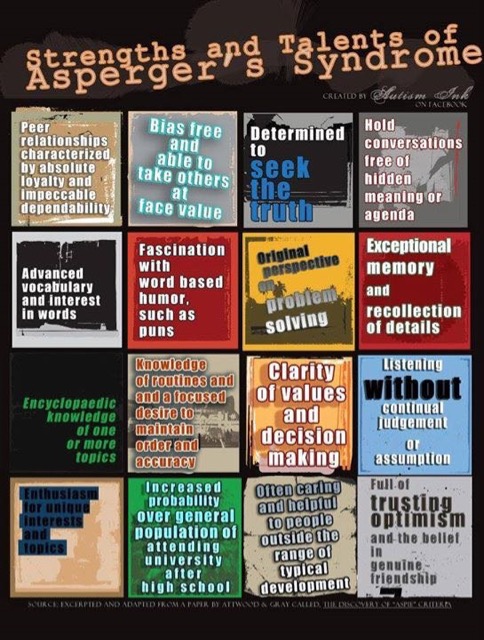
I have fused together the autistic traits of Obsessive Compulsive Disorder (OCD), logical thinking, detail oriented, pattern thinking, visual thinking, exceptional memory and recollection of details, determination to seek the truth, objective analysis and judgement, and most importantly “original perspective on problem solving.”

“So yes Dorothy, there are lots of positive things about being autistic. And I hope that I have made my point…” 🙂

[if not, please read the attached graphic carefully]

Aspergers_Strengths_Talents_2474